


Rental car damage claims are won or lost in the first 24 hours after a trip ends, long before anyone talks about money. If you rent on Turo, the platform's clock starts the moment the trip closes. If you run your own rental counter, state law and your rental agreement decide what you can recover. This guide walks through both, step by step, with the deadlines and evidence rules that trip up hosts most often.
A quick note on platforms first. Getaround announced in February 2025 that it was winding down its US operations, so US hosts reading this are mostly on Turo or renting direct. The Turo rules below are taken from its help center at the time of writing (October 2026). They change, so check the linked pages before you file.
The first 24 hours: what to do the moment you spot damage
Don't start by calling the renter or a body shop. Start by protecting your evidence and your deadline.
Photograph before anything else moves
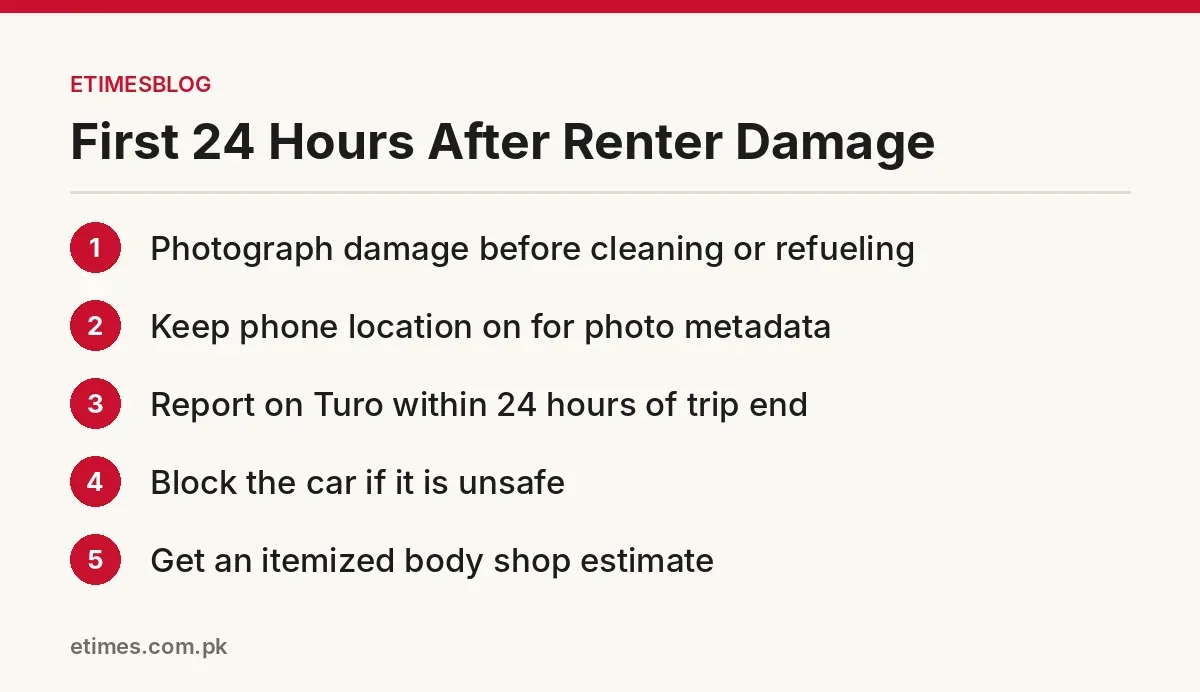
Walk around the car before you clean it, refuel it or hand it to the next renter. Shoot every damaged area from a distance to show where it sits on the car, then up close to show detail. Use your phone's camera app with location turned on, because Turo wants photos with date, time and location metadata. Screenshots or edited images lose that data.
Check the platform deadline
Turo says hosts must report damage "no more than 24 hours after the trip ends" to start the process. That applies to wrong-fuel damage too. A late report may not be eligible for reimbursement under your earnings plan, and it makes a direct settlement with the guest harder. Set a phone reminder for every trip end so you inspect the car inside that window.
Take the car off the road if it isn't safe
If the damage makes the car unsafe or undrivable, Turo restricts the listing so nobody can book it. You contact Turo to lift that restriction once you have evidence the repair is done. On a direct rental, block the dates in your own calendar so you don't double-book a car sitting in a shop.
Evidence that holds up in rental car damage claims
Most disputes come down to one question: was this damage there before the trip? Your job is to answer it with proof, not memory.
Pre-trip photos are your insurance policy
On Turo, pre-trip photos must be taken within 24 hours before the trip starts and uploaded within 24 hours after it starts. Post-trip photos must be taken and uploaded within 24 hours after the trip ends. Without the right photos you may not be eligible for physical damage reimbursement. Turo waives the post-trip photo rule for mechanical damage, or if the car was towed or otherwise unavailable to photograph.
Here's the routine I'd recommend for every handover, platform or not:
Four corners, both sides, front and rear, shot in the same order every time.
Close-ups of wheels, windshield, bumpers and any existing chips.
Interior: seats, headliner, dashboard warning lights, odometer and fuel level.
Same spot, same lighting where you can, so before-and-after shots compare cleanly.
Build the rest of the file
Photos are the core, but a complete file speeds everything up. Keep the trip messages, the rental agreement or trip record, fuel and mileage readings, and any toll or ticket notices from that period. Turo asks hosts to submit all relevant documents within 15 days of reporting the claim, and failing to send requested information can get the claim closed or denied.
Get a real repair estimate
When you report damage on Turo, you enter a body shop quote or your best estimate of the repair cost. A written repair estimate with parts and labor listed line by line is far easier to defend than a round number. For mechanical problems, Turo may ask for a diagnostic report from a dealer or mechanic, signed and on the business's letterhead. Its help page is clear that a repair estimate can't substitute for that diagnostic report.
Filing a Turo damage claim: direct settlement or claim
Once you report damage, Turo uses your estimate, your plan's damage responsibility and the guest's out-of-pocket maximum to show two numbers. One is what you could receive by settling directly with the guest. The other is what you could receive by filing a claim with Turo. You then pick a path.
When settling directly makes sense
Small, clear-cut damage is often quicker to settle with the guest. Keep every message inside the Turo app so there's a record if things go sideways. If the guest stalls, Turo's US host page says you generally have 20 days after the trip ends to escalate to a claim. You can go past that if you can show you've been actively working with the guest's personal insurer.
What the Turo claim process looks like
Turo's US help page sets out the steps and typical timings:
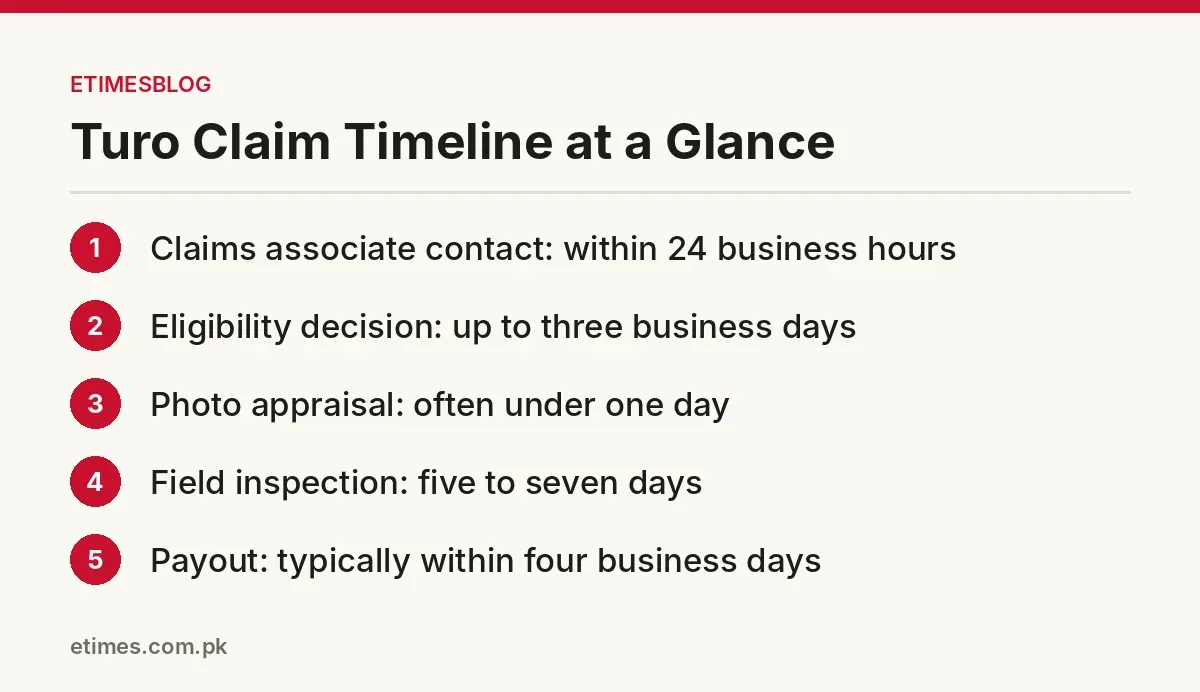
A claims associate contacts you within 24 business hours of filing.
Turo takes up to three business days to decide if the claim is eligible under your earnings plan. It checks for wear and tear, Terms of Service violations and prohibited use.
A third-party appraiser estimates the repair. Photo-based estimates often finish in under a day; field inspections take five to seven days.
Turo pays damage costs above your plan's damage responsibility. Funds typically reach your account within four business days of completing the payment link.
For a missing or stolen car, recovery can take up to 30 days from when Turo receives the police report. Read the Turo US host claims page yourself before your first claim, because it lists conditions that catch people out.
Repair shop rules to know before you book a repair
Two rules matter here. If Turo names a preferred vendor, the most your plan reimburses is what that vendor would charge, and any extra from your own shop is on you. And from August 18, 2026, Turo says repairs at certain facilities are no longer reimbursed, so confirm your shop is eligible first. Mechanical failure isn't covered unless it was clearly caused by guest negligence or intentional misuse.
Not sure what your damage responsibility is? Our guide to Turo protection plans and which one hosts should pick covers how the plans differ.
Common mistakes that cost hosts money
Turo charges hosts for weak or false claims, so a sloppy file can leave you worse off than not filing. Its host violation fees page lists, at the time of writing:
$25 per claim filed without valid, time-stamped pre- and post-trip photos.
$50 for a claim that is invalid or illegitimate.
$200 to $2,000 for material misrepresentation, meaning false or misleading information in a claim.
Most mistakes that sink rental car damage claims are avoidable:
Claiming old damage. If it's in an earlier trip's photos, it isn't this guest's problem. Turo treats pre-existing damage as an invalid claim.
Mixing wear with damage. Turo checks whether reported damage is really wear and tear. Worn parts are a maintenance cost, not a claim.
Fixing before documenting. Once the bumper is repaired, you can't prove what it looked like.
Rounding up the estimate. Inflated numbers invite disputes and, at worst, a misrepresentation fee.
Direct rentals: what you can recover under state law
If you rent cars outside a platform, there's no claims team between you and the renter. Your rental agreement and your state's law set the rules, and some states cap what you can charge a renter.
Example: California's rules
California's Civil Code section 1939.03 lists what a renter can agree to pay. Collision damage can be charged up to the car's fair market value. Vandalism unrelated to theft is capped at $500 in total. For theft, the renter is presumed not liable if an authorized driver returns the key and files a police report within 24 hours, subject to conditions.
The same section allows actual towing, storage and impound fees and an administrative charge, subject to limits in a related section. Other states set their own rules, and some are stricter on items like loss of use. Don't assume you can bill for downtime just because your agreement says so; check your state's statute or ask a local attorney.
Tighten your process before the next rental
A written agreement that spells out damage, theft, towing and fees in plain language.
A signed check-out and check-in condition sheet with matching photos.
The renter's insurance details collected at pickup, not after an accident.
An itemised repair estimate sent to the renter before you ask for payment.
If you're building a small rental business rather than hosting one car, your own coverage matters as much as the renter's. See our guide to rental fleet insurance options for small rental businesses, and browse more in our Insurance & Protection section.
FAQ
How long do I have to report damage on Turo?
At the time of writing, US hosts must report damage no more than 24 hours after the trip ends. Supporting documents are due within 15 days of reporting.
Can I claim loss of use for the days my car sits in the shop?
On direct rentals, it depends on your state, and some states don't allow it from renters. On Turo, check your earnings plan terms before you assume downtime is covered.
What if the guest says the damage was already there?
That's what pre-trip photos are for. Time-stamped photos with location data from before the trip are the strongest answer you have.
Should I fix the car before the claim is settled?
Not before it's documented and, on Turo, appraised. Confirm the shop is eligible for reimbursement first.
Final thoughts
Damage happens in this business. What separates hosts who get paid from hosts who don't is boring discipline: consistent photos, fast reports and honest estimates. Build that routine once, run it on every trip, and most rental car damage claims become paperwork instead of arguments.
This is general information, not legal, tax or insurance advice. Check the official terms for your situation.
ETIMESBLOG is independent and not affiliated with or endorsed by Turo, Getaround or any company mentioned.


Comments