


The best cars for Turo are not the flashiest cars in the lot. They are the ones that pass Turo's rules, get booked often in your city, and cost little enough to own that the payout actually covers the car and leaves something over.
This guide walks through how I'd pick a car to rent on Turo: the eligibility rules you can't ignore, the money math that decides whether a car earns, which vehicle types fit which guests, and the mistakes that sink new hosts. Plan details and figures are as stated on Turo's pages at the time of writing (October 2026), so check the linked pages before you buy.
Start with Turo vehicle requirements, not the dream car
Before you fall for a model, make sure Turo will accept it. A car that fails the rules is just a car payment. Turo's vehicle eligibility page for the US sets out the basics.
The rules that rule cars out
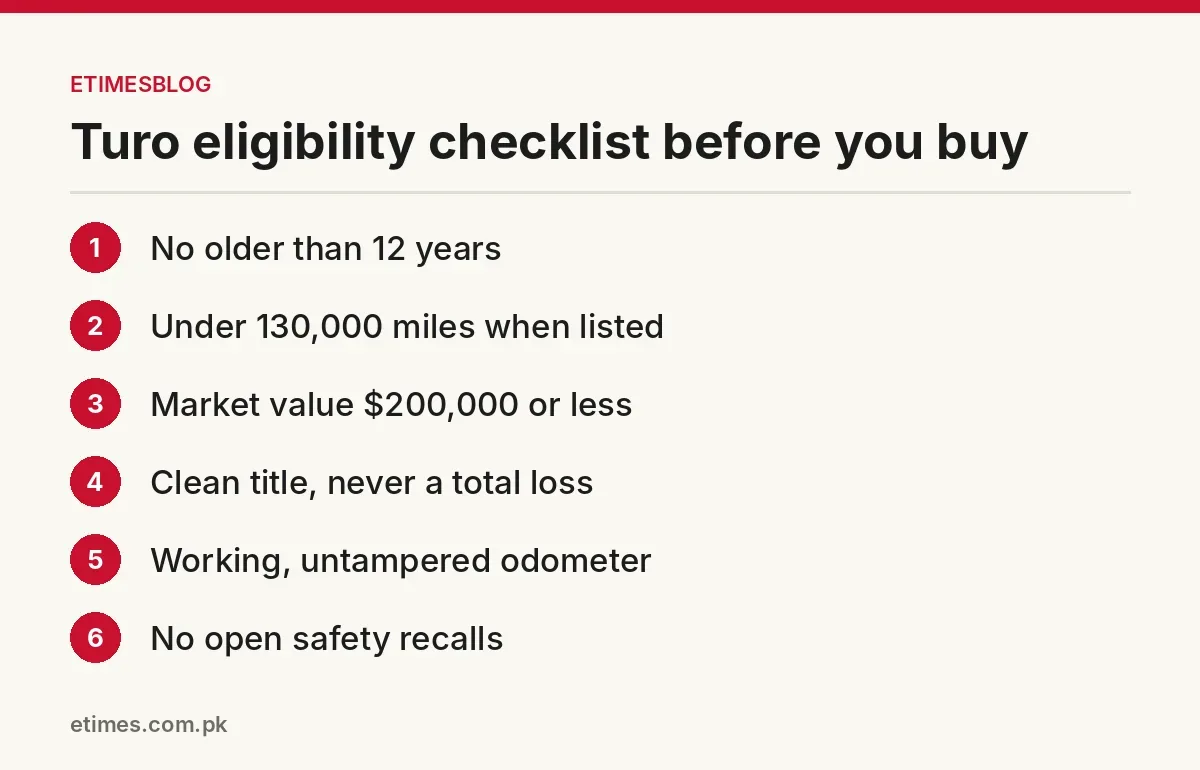
Age: the maximum is 12 years old. Turo says some classic or specialty vehicles may be exempt.
Mileage: fewer than 130,000 miles when you list. A car that crosses that mark later may stay listed if it is in excellent condition.
Value: fair market value can't exceed $200,000, which is also where Turo's actual cash value reimbursement tops out.
Title: it must be clean. Branded and salvage titles are not eligible, and the car can never have been declared a total loss.
Odometer: it has to work, and tampered odometers disqualify the car.
Plates: permanent, temporary or similar plates. Dealer plates are not allowed.
Vehicle types Turo won't take
Limousines, off-road vehicles, motorcycles, RVs, tow trucks and most three-wheelers are out. So are vehicles that need a commercial license and anything seating 16 or more. California caps seats at 10.
If you are buying used, run a vehicle history report before you pay. Turo puts the burden of knowing the title history on you, and a hidden branded title is an expensive surprise.
Check for open recalls before you buy
This one catches people. According to Turo's safety recall page for US hosts, you can't finish listing a car that has an open recall. Turo checks the VIN when you list and keeps checking while the car is on the platform.
What happens if a recall lands later
Turo says you must remove the car as soon as possible and no later than 72 hours after being notified, and cancel upcoming trips until it is fixed. If you don't, your earnings plan may be voided on trips taken in a car with an active recall. That means a model with a long list of recalls can sit idle while you wait for a dealer slot.
How to check a car yourself
Use the NHTSA recall lookup with the 17-character VIN before you sign anything. NHTSA notes that recall repairs are done free at a dealership, but the search won't show recalls more than 15 years old, and some recent recalls may not have every VIN loaded yet. Check again a week before your first trip.
The money math: what makes the most profitable car
A car earns when the payout beats the full cost of ownership, not just the loan payment. Turo's own "top-earning cars" research makes the same point. It found that cars that are cheap to own generally show the strongest return, and that lower daily prices tend to bring more frequent and longer bookings.
A worked example (hypothetical numbers)
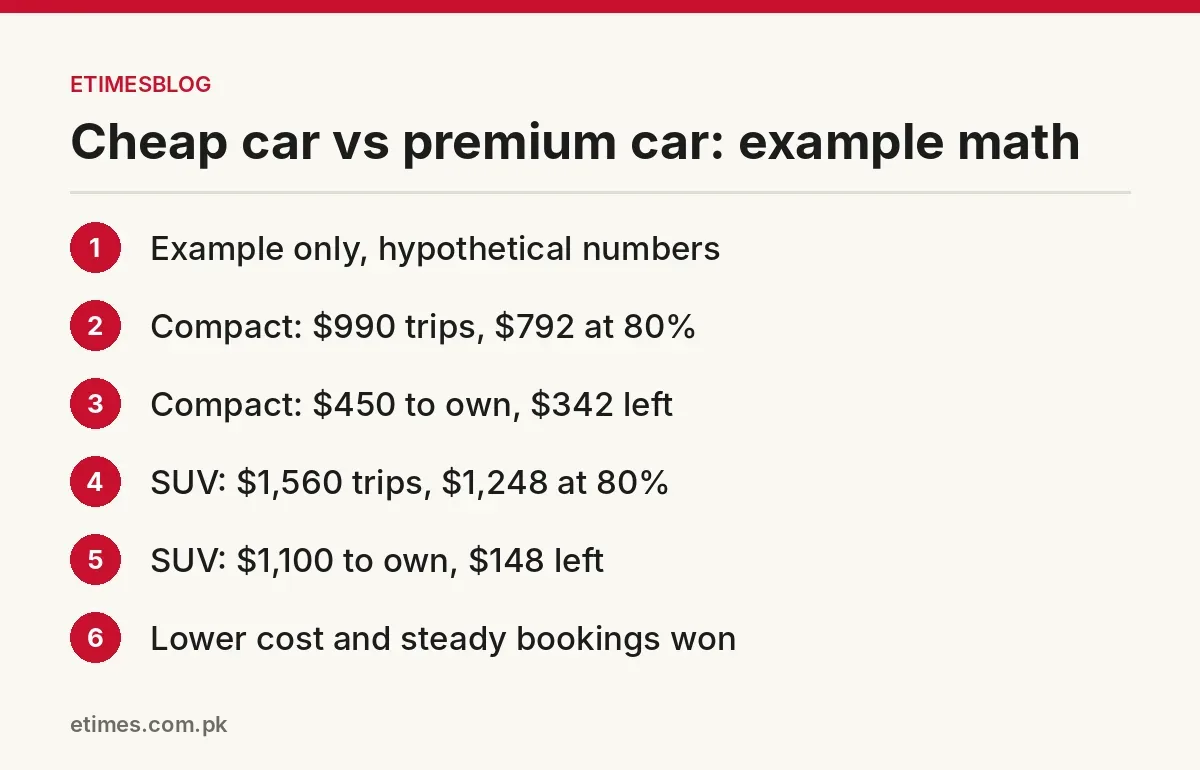
Say you are comparing two cars. These figures are made up to show the method, not real Turo data.
Car A, a compact sedan: costs $450 a month to own (payment, insurance, maintenance reserve). It books 18 days a month at $55 a day, so $990 in trip price.
Car B, a premium SUV: costs $1,100 a month to own. It books 12 days a month at $130 a day, so $1,560 in trip price.
On a plan where you keep 80% of the trip price, Car A pays you $792 and Car B pays you $1,248. Subtract ownership cost and Car A leaves $342 while Car B leaves $148. The bigger rate lost, because the car cost more to carry and booked less often.
Costs people forget
Cleaning supplies or a car wash between every trip.
Tires and brakes, which wear faster on a shared car.
Depreciation from the extra miles guests put on.
Your damage responsibility on each claim, which depends on the plan you pick (see our guide to Turo protection plans).
Parking, tolls admin and time spent on handoffs.
Turo's top-earning cars study also excluded depreciation, maintenance, parking, cleaning and damage claims from its figures. That is a good reminder that published earnings are a starting point, not your profit.
Best cars for Turo by guest type
Turo's own blog post on cars for earning extra income says there is no single best car for hosting. I agree. The right car depends on who books in your area.
Compact and fuel-efficient cars
Turo points to compact sedans and hatchbacks such as the Toyota Corolla and Mazda3 for city and everyday use, and calls them a low-friction way to start. They are cheap to buy, cheap to fix and easy for any guest to drive. If this is your first car on the platform, this is where I'd begin.
Mid-size sedans and SUVs
For airports, tourist areas and places with weak public transport, Turo suggests mid-size options like the Toyota Camry and Subaru Outback. In those markets, it says location and delivery options matter more than the exact model.
Large SUVs, minivans and passenger vans
Families and groups book these for road trips, and Turo notes longer bookings can mean steadier income. Turo's October 2026 article gives category estimates of about $30,000 a year for large SUVs and $35,000 to $50,000 for passenger vans. Those are Turo's estimates and depend on price, availability and demand, so treat them as a ceiling to test, not a promise.
EVs and plug-in hybrids
Turo lists EVs and plug-in hybrids as a fit for commuters and longer stays, but only where charging is easy. Check how close guests can charge before you list one. An EV returned with a flat battery in a charging desert is a support ticket, not a booking.
Convertibles and sports cars
These appeal to travelers who want something special, and they can carry higher daily rates. They are also seasonal: Turo notes convertibles peak in warm months. Unless you are in a warm tourist market, I'd treat them as a second or third car, not the first.
Use data from your own market
National lists are interesting, but bookings are local. Before buying, I'd do three things.
Search Turo like a guest
Search your city for your target dates and look at what is already listed. If there are dozens of the same compact SUV, a minivan or a pickup might fill a gap with less competition. Turo's blog suggests the same approach.
Run the Turo Carculator
The Turo Carculator estimates earnings for specific models in different markets. Use it to compare two or three shortlisted cars, then run the numbers through your own ownership cost. Keep in mind that Turo's older top-earning cars study used data from October 2017 to October 2021, and that Turo itself says past performance doesn't predict future results.
Check the seasons
Think about when your market books. Ski towns, beach towns and college towns all have different peaks, and a car that only earns three months a year needs to earn a lot in those months.
Common mistakes when picking a Turo car
Buying on daily rate alone. A high rate with low bookings can earn less than a cheap car that rarely sits.
Skipping the recall check. An open recall blocks the listing.
Buying near the age or mileage limit. A car that is 11 years old has very little listing life left under the 12-year rule.
Ignoring parts and repair costs. Rare or premium models can mean long waits and big bills.
Copying someone else's market. What works at a big-city airport may not work in a small town.
Financing too much car. A large payment leaves no cushion for a slow month.
Once you have a car in mind, the next steps are covered in our guides on how to start a Turo business and what Turo hosts really earn and keep. More platform guides sit in our car sharing platforms section.
FAQ
What is the oldest car I can list on Turo?
Turo's US eligibility page sets a maximum age of 12 years, with possible exemptions for classic or specialty vehicles.
Can I list a car with a salvage title?
No. Turo requires a clean title, and cars with branded or salvage titles, or that were ever declared a total loss, are not eligible.
Are expensive cars more profitable on Turo?
Not always. Turo's own research found cheaper-to-own cars generally showed the strongest return relative to cost, even though premium cars charge more per day.
Should my first Turo car be an EV?
Only if charging is easy near you and your guests. Otherwise a fuel-efficient compact is the easier start.
Final thoughts
When people ask me for the best cars for Turo, I give the same answer: the car that is cheap to own, easy to fix, eligible for years, and in demand where you live. Do the math with your real costs, check recalls and title history, and start with one sensible car before you chase the exciting ones.
This is general information, not legal, tax or insurance advice. Check the official terms for your situation.
ETIMESBLOG is independent and not affiliated with or endorsed by Turo, Getaround or any company mentioned.


Comments