


If you are searching "Turo vs Getaround" because you want to pick a platform for your car, start with one fact: Getaround no longer runs car sharing in the United States. The company announced a wind-down of its US business in February 2025, and hosts lost that income stream almost overnight. So this is not a normal side-by-side review. It covers where US hosts stand now, what Turo offers at the time of writing, and what the shutdown should change about how you run your business.
Turo vs Getaround in 2026: the short answer
For a US host in October 2026, the Turo vs Getaround question has a one-line answer. Turo is still operating and taking new listings. Getaround is not available for US rentals.
That does not make Turo perfect, and it does not mean you should put every car you own on a single app. The more useful question is how to choose and use any car sharing platform without being wiped out if it changes its terms or disappears. The rest of this guide covers that.
If you are a new host: compare Turo's earnings plans carefully and look at direct bookings as a second channel later.
If you were a Getaround host: check whether your cars meet Turo's eligibility rules before you spend money preparing them.
If you already host on Turo: use the Getaround story as a reason to build some independence into your business.
What happened when Getaround shut down in the US
Getaround's own press release, filed with the SEC, said the company planned "an orderly wind-down" of its US operations, covering both its car-share business and HyreCar. The interim CEO pointed to an ongoing lack of liquidity that made US operations no longer viable. Its European business was meant to continue.
The timeline
February 11, 2025: Getaround announced the US wind-down.
February 12, 2025: according to NerdWallet's report on the Getaround shutdown, US operations stopped effective immediately and future bookings were cancelled.
May 2026: Getaround combined its European business with GoMore, a Danish car-sharing company, according to the law firm that advised Getaround on the deal.
What it meant for hosts
NerdWallet reported that hosts could no longer rent out their cars through the platform. Renters had to return vehicles by the end of the shutdown day. After that, they might be personally responsible for damage, because insurance may no longer cover them. At the time, it was unclear how host payments and pre-shutdown claims would be handled; the company said those would go through a wind-down process.
Think about what that means for a host with financed cars. The payments keep coming. The booking income stops. Any open damage claim sits in limbo.
How Turo works for hosts at the time of writing
Since Turo is the main peer-to-peer option left for US hosts, it is worth knowing its terms properly. Everything below comes from Turo's US help and vehicle protection pages at the time of writing (October 2026). Turo changes plans and fees, so check the official pages before you list.
Turo host share and protection plans
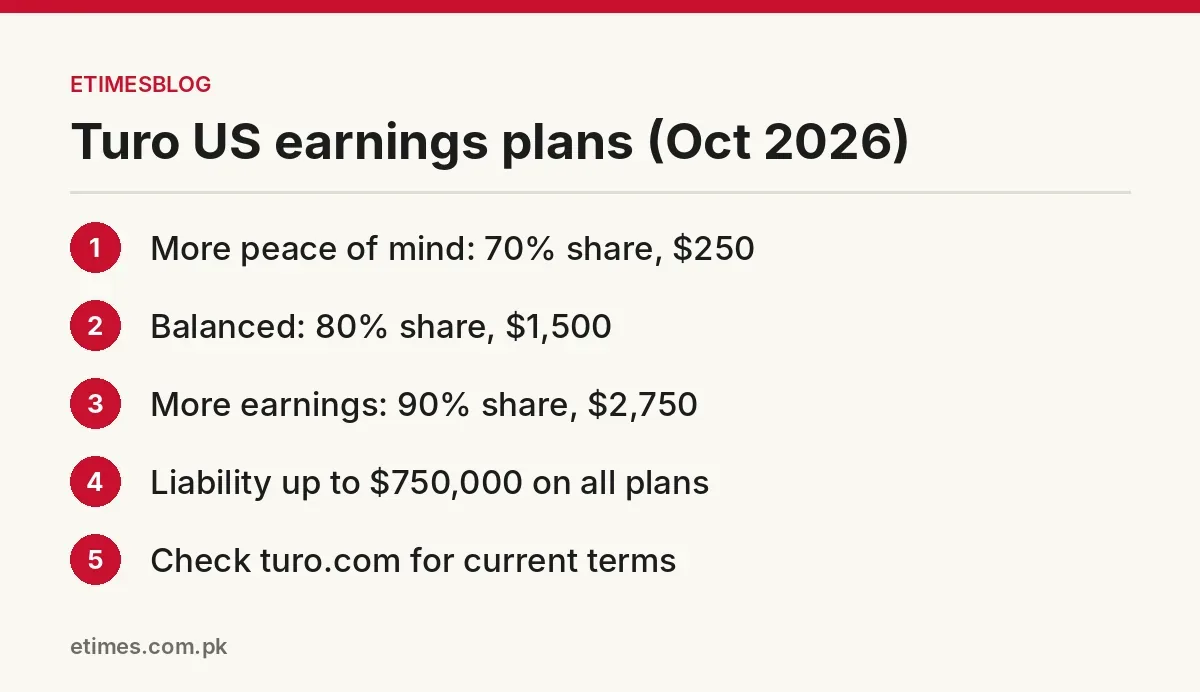
Your Turo host share is the percentage of the trip price you keep. In the US, your earnings plan sets both that share and your damage responsibility. Turo's vehicle protection page lists three plans:
More peace of mind: 70% host share, $250 damage responsibility.
Balanced: 80% host share, $1,500 damage responsibility.
More earnings: 90% host share, $2,750 damage responsibility.
All three list third-party liability insurance of up to $750,000, provided through a Travelers policy. For physical damage, Turo says it reimburses eligible costs above your damage responsibility, up to the lesser of actual cash value or $200,000. It also states that it is not an insurer for physical damage. For a deeper breakdown, read our guide to choosing between Turo protection plans.
Variable host share in some cities
Turo's earnings help page says that in Austin, Dallas, Detroit, Las Vegas, Maui, Philadelphia, Phoenix, San Diego and Seattle, host share varies with how far ahead the trip is booked. On the More earnings plan, for example, it runs from 85% for trips booked 0–2 days ahead up to 100% for trips booked 28 or more days ahead. If you host in one of those cities, advance bookings are worth more to you than the headline plan suggests.
What Turo does not cover
Turo's protection page lists some exclusions that catch new hosts out. Wear and tear, including dings, dents, cracks or scratches of 3 inches or less, is not covered. Neither is lost hosting income while a car is in the shop, or a replacement vehicle during repairs. You also need clear start and end photos in the app and must report damage within 24 hours of trip end.
Vehicle eligibility
Turo's US eligibility page sets these limits at the time of writing:
No more than 12 years old (classic and specialty cars are handled separately).
Fewer than 130,000 miles when listed.
Fair market value of no more than $200,000.
A clean title, and never declared a total loss.
Some vehicle types are not eligible at all, such as motorcycles, RVs, limousines and vehicles that need a commercial licence.
What the Getaround shutdown teaches every car sharing platform host
I don't think the lesson is "Turo good, Getaround bad." The lesson is that a car sharing platform is a sales channel you rent, not an asset you own. Here is how I'd apply that.
Lesson 1: one platform is one point of failure
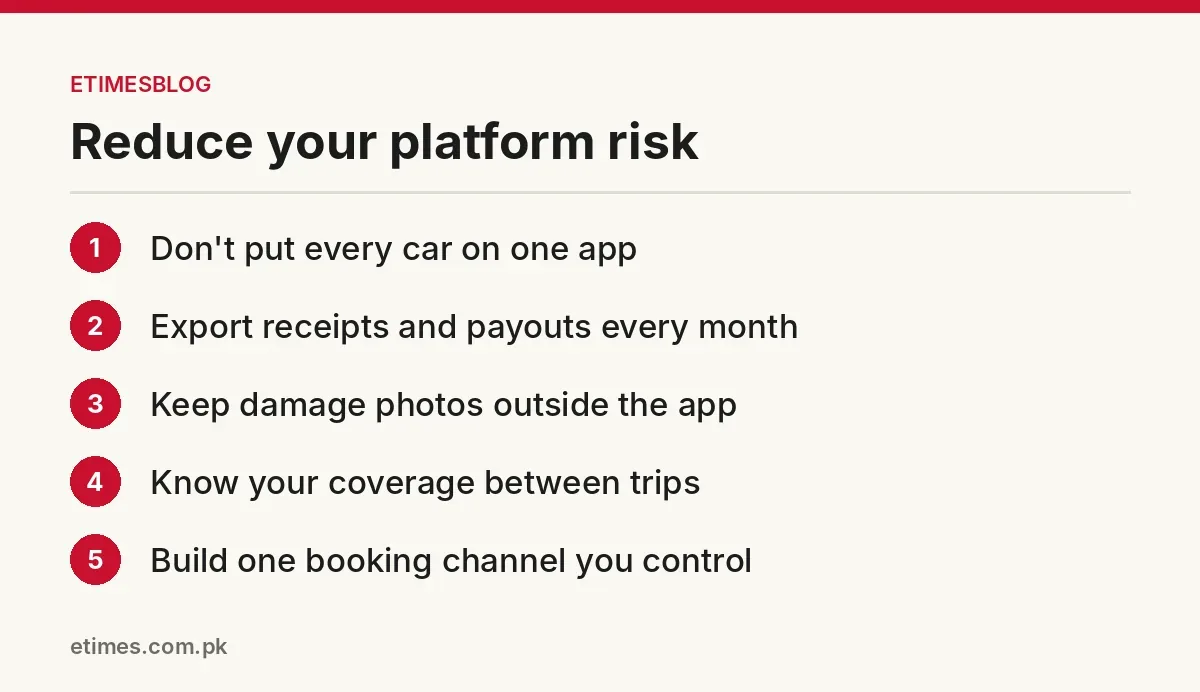
If 100% of your bookings come from one app, a policy change, an account suspension or a shutdown hits all your cars on the same day. You can't fully remove that risk. You can reduce it, though. Keep a list of repeat guests within the platform's rules, build a simple direct-booking option, or keep a car or two for local long-term rentals.
Lesson 2: keep your own records
Hosts caught in the Getaround shutdown had open questions about payouts and claims. Don't rely on any app as your only record. Export or screenshot trip receipts, payout history, damage photos and claim messages on a regular schedule.
Lesson 3: know where coverage comes from
Platform protection exists only while a trip is active on that platform. When the platform stops, so does that protection. Make sure your own policy situation is clear for any car that is not on an active platform trip.
Choosing a Getaround alternative as a former host
If you had cars on Getaround, you have likely moved them already. If not, here is a simple order of work before you list anywhere else.
A checklist before you switch
Check eligibility first. Compare each car's age, mileage, title and value against Turo's US rules above.
Pick an earnings plan on purpose. Ask yourself if you could pay a $2,750 damage bill tomorrow without stress. If not, the 90% plan may be the wrong choice.
Rework your numbers. Your old payouts are not a guide to new ones. Recalculate using the new host share and a realistic booking estimate.
Plan for photos and reporting. Turo's 24-hour damage reporting rule means you need a check-in routine you actually follow.
Read the current terms. Plans, fees and city rules change, so read the official pages on the day you sign up.
Our guide to Turo host earnings and what you really keep walks through the math in more detail.
What I'd do
I'd list on Turo with the Balanced plan as a starting point, then adjust after a few months of real claim history. I'd also keep a short list of local contacts, such as body shops and long-term renters. That way, cars are not idle if the app has a bad month.
Common mistakes when comparing platforms
Trusting old comparison articles. Many "Turo vs Getaround" posts online were written before February 2025 and still describe Getaround as a US option.
Looking only at the host share. A higher percentage usually comes with higher damage responsibility.
Ignoring the exclusions. Small scratches and lost income while a car is repaired come out of your pocket.
Listing a car that will soon be ineligible. A car close to 130,000 miles or 12 years old has a shorter earning window.
No backup plan. The hosts who coped best with the Getaround shutdown were the ones with somewhere else to send their cars.
You can find more platform guides in our car sharing platforms section, including how to start a Turo business step by step.
FAQ
Can I still list my car on Getaround in the US?
No. Getaround announced a wind-down of its US operations in February 2025, and US rentals stopped. Its European business was combined with GoMore in 2026.
Is Turo the only peer-to-peer option for US hosts?
Turo is the best-known one still operating, and NerdWallet described it as the option most similar to Getaround. Check for local platforms in your area, and read their terms and insurance details before listing.
Which Turo plan should a former Getaround host choose?
It depends on how much damage cost you can absorb. The 70%, 80% and 90% plans come with $250, $1,500 and $2,750 damage responsibility at the time of writing.
Does Turo pay me if my car is in the shop after a claim?
Turo's vehicle protection page says lost hosting income is not covered. Budget for downtime when you price your car.
Final thoughts
The Turo vs Getaround debate is settled for US hosts, but not in the way old reviews predicted. Turo is the main peer-to-peer platform left, and its plans give you a clear trade-off between earnings and risk. Pick that trade-off deliberately, keep your own records, and build at least one booking channel you control.
This is general information, not legal, tax or insurance advice. Check the official terms for your situation.
ETIMESBLOG is independent and not affiliated with or endorsed by Turo, Getaround or any company mentioned.


Comments