


Rental fleet insurance is the cost most new rental owners underestimate and the one that can end the business fastest if it's wrong. Whether you list two cars on Turo or run ten from your own lot, someone has to cover liability when a renter hits another car, and someone has to pay when your car comes back crumpled. This guide breaks down the coverage options, the gaps between them and the questions to ask before you sign anything.
Coverage details below come from insurer explainers, federal law and Turo's US help pages at the time of writing (October 2026). Policies and platform plans change, so treat this as a map, not a quote.
Why a personal auto policy isn't rental fleet insurance
A personal auto policy is priced for you driving your own car. Renting that car to strangers is a different risk, and insurers write their policies with that in mind.
Exclusions you need to look for
Personal policies can exclude cars that are rented out or shared, and some states expressly allow it. West Virginia's code (section 17A-6F-5), for example, lets insurers exclude "any and all coverage" under a personal policy for a shared vehicle. Read your own policy's exclusions page and ask your agent directly, in writing.
Don't hide business use
Telling your personal insurer nothing and hoping is the worst option. If a claim reveals the car was rented out, you may learn at the worst moment that you aren't covered. That's a bad outcome on a fender bender and a disaster on a serious injury claim.
The building blocks of rental fleet insurance
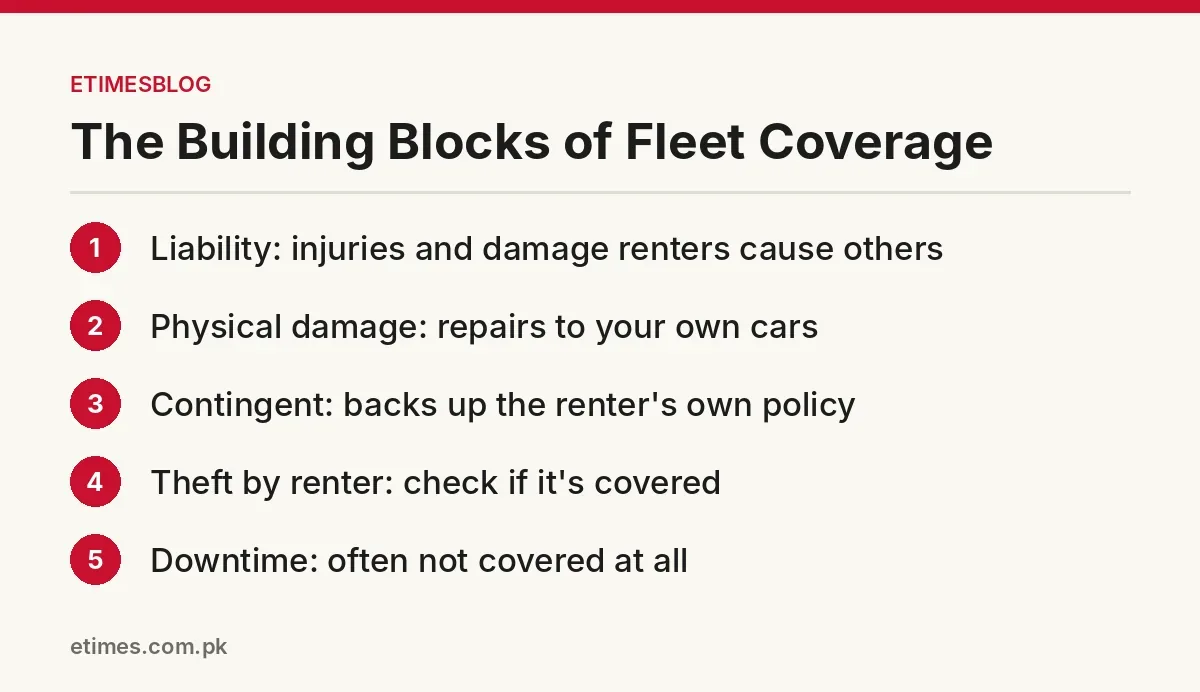
Most small rental owners build coverage from a few standard pieces. The names vary by insurer, but the jobs they do are the same.
Liability coverage
This pays for injuries and property damage your renter causes to other people. It's the piece that protects your business from a lawsuit after a crash. State law sets a minimum, but minimums are low compared with a serious accident, so ask what higher limits cost.
Physical damage coverage
Collision and comprehensive coverage pay to repair or replace your own cars. A commercial auto insurance quote can be liability only, so confirm physical damage coverage is actually on the policy. If your cars are financed, check what insurance your loan agreement requires.
Contingent liability and the renter's own insurance
Some rental businesses require renters to carry their own insurance and buy contingent coverage on top. A 2015 PropertyCasualty360 explainer of standard business auto endorsements describes one: it applies only if the renter's certificate is on file and the renter's insurance is "not collectible" at the time of the accident. That's cheaper than primary coverage, but it puts more paperwork and verification on you at every pickup.
The theft-by-renter gap
The same explainer covers an endorsement that excludes theft, conversion or embezzlement by someone in possession of the car under a rental. Coverage can be bought back, but with a limit of 75 percent of actual cash value less any security deposit. In plain terms: a renter who drives off and never returns may not be covered unless you ask for it. Ask your agent how your policy handles that scenario.
Platform protection vs your own commercial policy
If you host on Turo, you're choosing between the platform's protection and your own commercial insurance. You can't stack them.
What Turo provides US hosts
Turo's small business page says hosts are covered with $750,000 in third-party liability insurance from Travelers, except in some states and at some airports that require more. Its help center adds that, from June 17, 2026, the default limit in New York is the state minimum for peer-to-peer vehicle sharing. Damage to your own car is handled through earnings plans, not that liability policy.
At the time of writing, Turo lists three US earnings plans:
More peace of mind: 70% of the trip price, $250 damage responsibility per claim.
Balanced: 80% of the trip price, $1,500 damage responsibility per claim.
More earnings: 90% of the trip price, $2,750 damage responsibility per claim.
For a full breakdown, see our guide to Turo protection plans and which plan hosts should pick.
The gaps in platform protection
Turo's earnings plan page lists what isn't covered. That includes diminished value after a repair, mechanical failure, wear and tear, and damage during the delivery period. Loss of hosting income and replacement vehicle reimbursement aren't included in any US host plan. If one car funds your loan payment, a month in the body shop comes out of your pocket either way.
Bringing your own commercial insurance
Turo says hosts who bring their own commercial rental insurance "do not receive Turo coverage for their vehicles or their customers." That means your policy has to do the whole job: liability, physical damage and any theft cover. It can make sense once you have enough cars that a commercial policy costs less than the earnings share you give up. Run the numbers for your own fleet before you switch.
A worked example
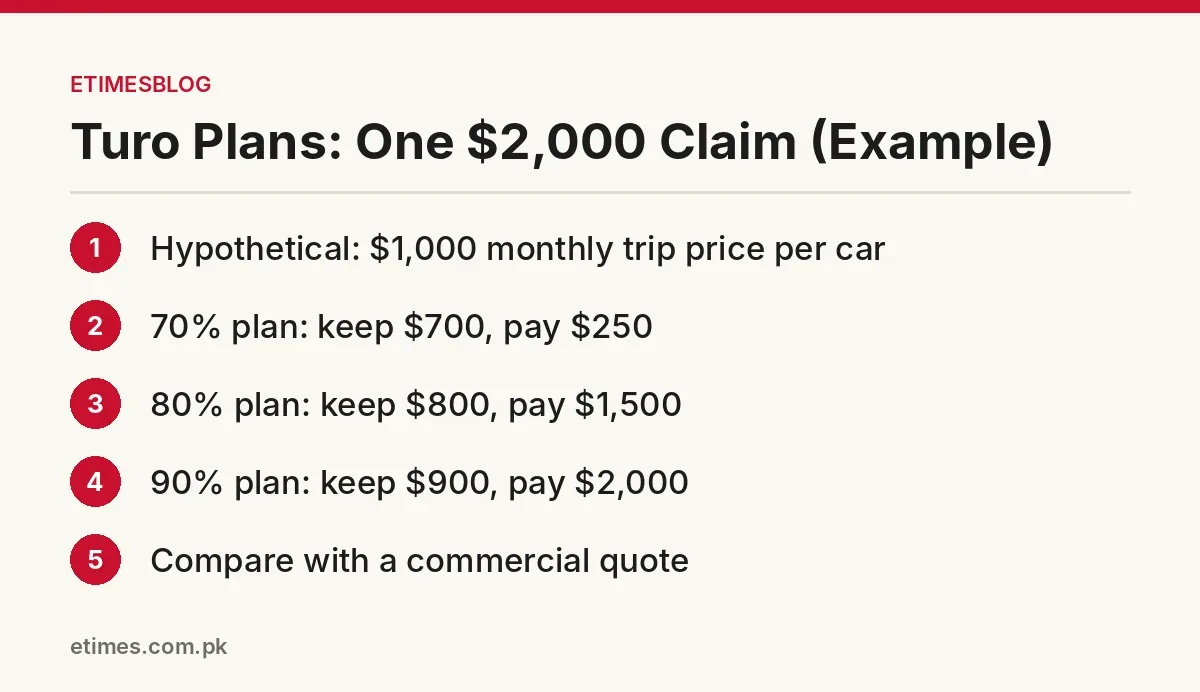
Here's a hypothetical: say one car brings in $1,000 a month in trip price. On the 70% plan you keep $700, on the 80% plan $800, and on the 90% plan $900. Now say a guest causes $2,000 of covered damage. Your share is $250, $1,500 or $2,000 respectively, since the $2,750 responsibility exceeds the bill.
Over 12 months, the 80% plan earns $1,200 more than the 70% plan, but that one claim costs you $1,250 more. The 90% plan earns $2,400 more and costs $1,750 more on the claim. Run the same math across your cars with your real claim history, then compare it with a commercial quote for the same fleet.
Peer-to-peer car sharing laws and the Graves Amendment
Two pieces of law shape who pays when a renter causes harm. Neither replaces insurance, but both affect what you need.
State peer-to-peer car sharing laws
A 2024 National Academies guide on peer-to-peer carsharing counts about 30 jurisdictions with at least some peer-to-peer car sharing legislation as of November 2023. Most include insurance provisions, many based on a model act from NCOIL, a national group of state insurance legislators. In those states the platform can be primarily liable during the sharing period. Some states also bar insurers from canceling a personal policy merely because the owner shares the car.
The Graves Amendment
The Graves Amendment (49 U.S.C. 30106) is a federal law from 2005. It says an owner in the business of renting or leasing vehicles isn't liable under state law just for owning a car a renter was driving. That protection holds only if there's no negligence or criminal wrongdoing by the owner.
Two catches matter for small operators. First, it doesn't override state insurance or financial responsibility rules, so you still need the coverage your state requires. Second, negligence on your part, such as renting out a car with a known brake problem, takes the protection away. Good maintenance records are part of your insurance strategy.
How to shop for rental fleet insurance
I'd start with an independent agent who already insures rental or car sharing businesses and can quote commercial auto insurance from more than one carrier. Get the answers below in writing before you compare prices.
Questions to ask every insurer
Does this policy cover cars rented to the public, and on which platforms?
Is liability primary, or contingent on the renter's insurance?
What are the liability limits, and what do higher limits cost?
Is theft or conversion by a renter covered?
Is loss of use or rental income covered while a car is repaired?
Are there driver age, license or screening requirements?
Common mistakes
Buying state minimum liability. It's the cheapest line on the quote and the riskiest.
Assuming the platform covers everything. Read the exclusions list, not just the headline limit.
Skipping the renter's paperwork. Contingent cover depends on having proof of their insurance on file.
Forgetting downtime. Budget for repair days your plan or policy won't pay for.
When damage does happen, the process matters as much as the policy. Our guide to handling rental car damage claims after a renter damages your car covers the evidence side. More guides are in our Insurance & Protection section.
FAQ
Do I need commercial insurance to host on Turo?
Not in the US at the time of writing. Turo provides liability coverage and earnings plans, but hosts who bring their own commercial rental insurance don't get Turo's coverage.
Does the Graves Amendment mean I don't need liability insurance?
No. It limits liability based only on ownership, but it doesn't override state insurance requirements or protect you if you were negligent.
Is rental fleet insurance expensive?
It varies with your state, cars, limits and claims history. Get several quotes and compare them against what platform protection costs you in earnings.
Will my personal policy cover a car I rent out?
Often not. Personal policies can exclude cars that are rented out or shared, so ask your insurer in writing.
Final thoughts
Insurance is the one part of a rental business where cheap and wrong costs far more than it saves. Know which policy pays for liability, which pays for your cars and which gaps you're carrying yourself. If you can answer those three questions for every car in your fleet, you're ahead of most new owners.
This is general information, not legal, tax or insurance advice. Check the official terms for your situation.
ETIMESBLOG is independent and not affiliated with or endorsed by Turo, Getaround or any company mentioned.


Comments