


Good rental car pricing starts with your own costs, not with what the car down the street charges. If you copy a competitor's daily rate without knowing your break-even rate, you can be fully booked and still lose money. This guide shows you how to build a daily rental rate from the bottom up, check it against the market, and use Turo's pricing tools and discounts without giving away your margin.
Start rental car pricing with your real cost per month
Before you think about demand, write down what the car costs you every month whether it is booked or not. These are your fixed costs, and your rate has to cover them across the days the car actually earns.
Costs to include
Car payment or depreciation. If the car is paid off, it is still losing value every month.
Insurance and registration. Spread annual bills over 12 months.
Maintenance and tires. Rental cars rack up miles fast, so set aside a reserve every month.
Cleaning and supplies. Count your own time too, or what you pay someone.
Tracking, parking and tolls equipment. Small monthly items add up across a fleet.
Damage you absorb. Small scratches and your plan's damage responsibility are real costs.
For a sense of scale, AAA's 2025 Your Driving Costs study put the average cost of owning a new vehicle at $11,577 a year. That assumes 15,000 miles a year over five years, and depreciation was the single largest item at $4,334. Rental cars often drive more than that, so your wear costs can run higher.
Work out your break-even rate
Your break-even rate is the daily price that covers your monthly costs at a realistic number of booked days. On Turo, you also need to account for the host share, because you only keep a percentage of the trip price.
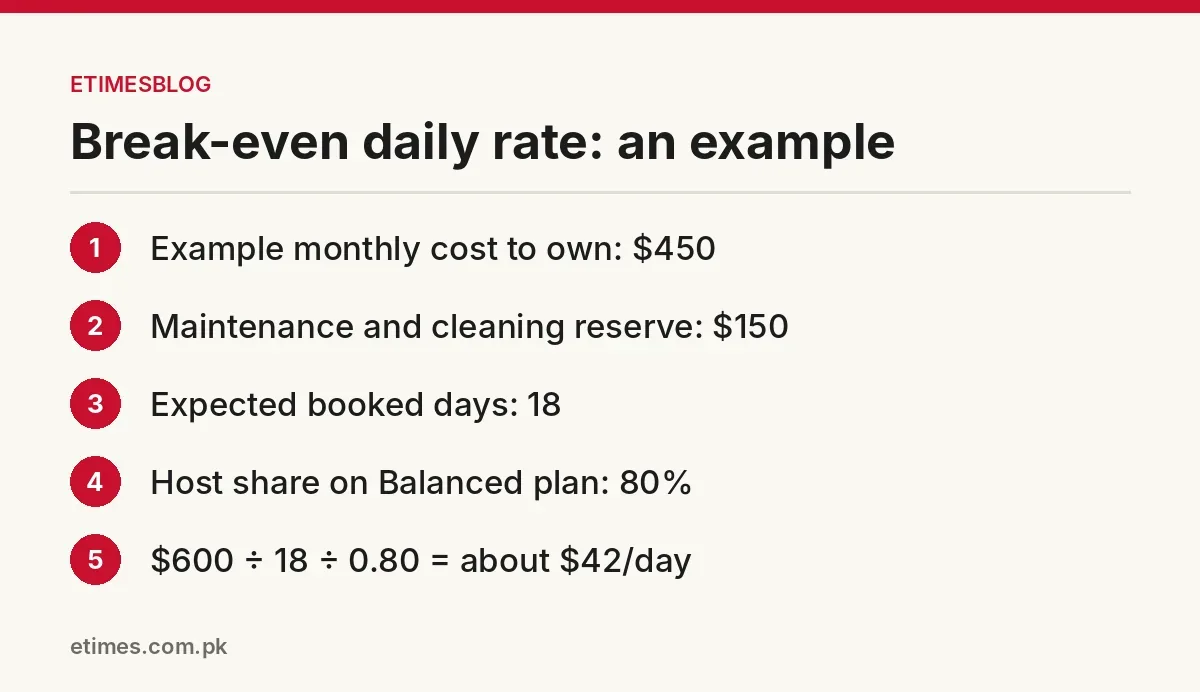
A worked example
These numbers are hypothetical, just to show the method. Say your car costs $450 a month to own (payment, insurance, registration) and you set aside $150 a month for maintenance and cleaning. That is $600 a month in costs.
Now say you expect the car to be booked 18 days a month, and you are on Turo's Balanced plan. At the time of writing, Turo's vehicle protection page lists that plan at an 80% host share. The formula looks like this:
Break-even trip price per day = monthly costs ÷ booked days ÷ host share
$600 ÷ 18 ÷ 0.80 = about $42 a day
Anything below $42 a day, in this example, loses money. Add a profit target and the number moves. With a $400 monthly profit goal, the same math gives $1,000 ÷ 18 ÷ 0.80, or about $69 a day.
Why the utilization rate matters so much
Your utilization rate is the share of days the car is booked. Run the same $1,000 target at 12 booked days instead of 18, and the required rate jumps to about $104 a day. That is why a car that sits idle half the month needs a much higher rate to earn the same money. Be honest about bookings in your first months; a new listing with no reviews rarely books like an established one.
Check your daily rental rate against the market
Once you know your floor, look at what similar cars in your area charge. Search the platform as a guest would, using the same dates, a similar pickup spot and comparable cars. Note the price range, not just the cheapest listing.
Position your car, don't just match prices
If your break-even rate sits below the local range, you have room to price in the middle and build reviews. If it sits above the range, a lower price will not fix the problem. You either need cheaper costs, more booked days, or a different car. Our guide to choosing a car that earns on Turo covers that last option.
Things that justify a higher rate
Delivery to airports or hotels
Strong reviews and fast responses
Extra seats, cargo space or all-wheel drive in the right season
Spotless presentation and clear photos
Using Turo automatic pricing without losing control
Turo's pricing help page says its automatic (dynamic) pricing applies to all listings. It balances price against the chance of a booking. Inputs include the car's make, model and market value, real-time guest searches, past booked prices and utilization for your car and similar cars, and local demand forecasts.
When to override it
You can set your own prices for single dates or date ranges from the calendar after a short required tutorial. I'd override for local events the algorithm may not weigh properly, and for slow weeks where your break-even rate matters more than a booking at any price.
Pricing alerts and boosts to know about
The 20% alert: at the time of writing, if you price 20% or more above the recommended price, those days are shaded yellow. Turo warns the car may rank lower in search.
Future prices chart: shows dynamic recommendations for the next 90 days, updated daily.
Last-minute boost: new listings are opted in to a 5% boost for same-day bookings when advance notice is under 24 hours. You can change or remove it in trip preferences.
Discounts: where rental car pricing quietly leaks money
Discounts are the easiest place to lose margin without noticing. Turo's discounts help page says all new listings are automatically enrolled in trip-length discounts. Check yours before your first booking.
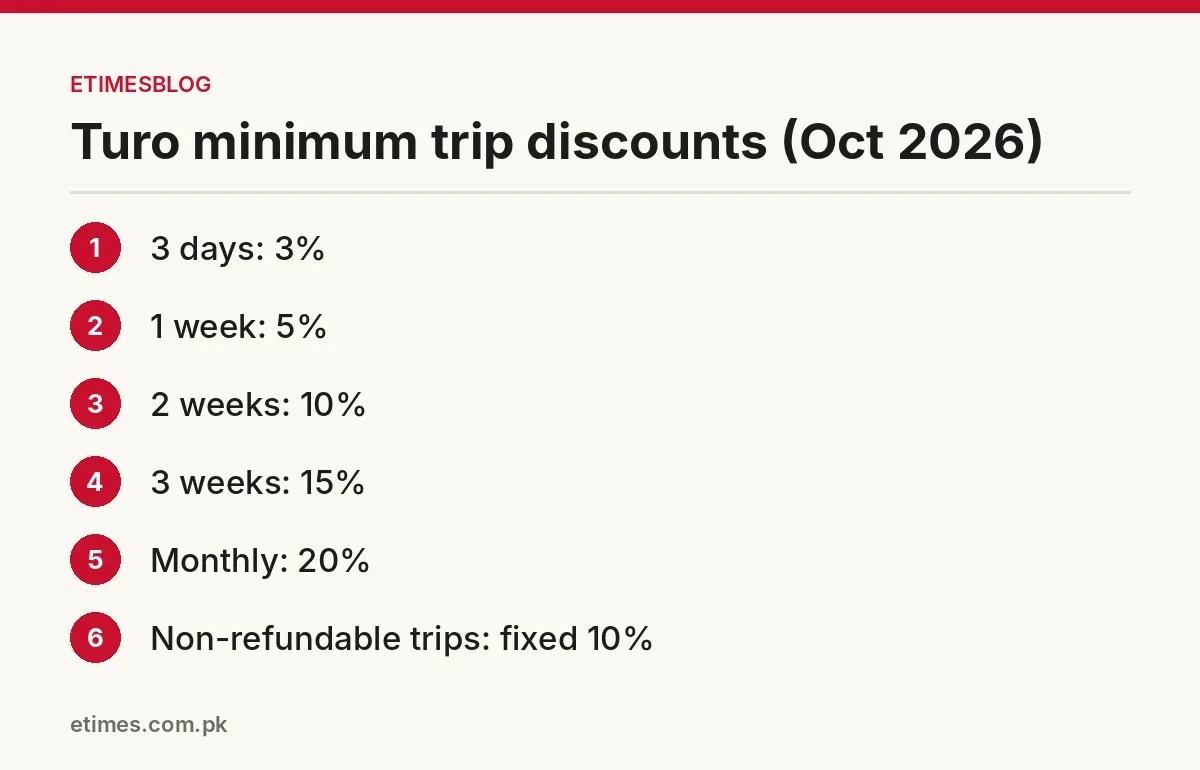
The minimum discounts
At the time of writing, Turo's minimum trip-length discounts are 3% for three days, 5% for one week, 10% for two weeks, 15% for three weeks and 20% for a monthly trip. Longer-trip discounts must be at least as large as shorter ones. To opt out of one, set your maximum trip length below that threshold, such as 29 days to opt out of monthly.
There is also a fixed 10% discount for non-refundable trips booked four or more days ahead. Turo's page says hosts can't change that rate or opt out, so build it into your math.
Is a monthly discount worth it?
Turo's June 2026 host update lowered its recommended monthly discounts. It suggests a monthly discount may suit cars booked about half the month or less. If a car is booked more than half the month, shorter trips likely earn more. Turo also notes that month-long trips have historically had significantly fewer claims, and they cut handovers and cleaning.
A hypothetical example: at $70 a day, a 30-day trip with a 20% monthly discount brings in $1,680 before fees. At a 45% discount it brings in $1,155. If you could book 18 short-trip days at $70 instead, that is $1,260, but with more cleaning and handovers. Run your own version before you pick a monthly discount.
Common rental car pricing mistakes
Copying the cheapest competitor. Their costs and their goals are not yours.
Forgetting the host share. A $60 trip price is not $60 in your pocket.
Never checking default discounts. Auto-enrolled discounts can stack with the non-refundable discount.
Pricing every day the same. Weekends, holidays and local events deserve different rates.
Ignoring downtime. Repairs, cleaning and slow weeks reduce booked days, so they raise your break-even rate.
What I'd do each month
Recalculate costs and booked days for each car.
Update the break-even rate and set it as your mental floor.
Compare against local listings for the next four weeks.
Review discounts and adjust for the season.
For more on running the numbers, see our car rental business guides and our breakdown of Turo host earnings and what you really keep.
FAQ
How do I calculate a daily rental rate?
Add up your monthly costs, divide by the days you realistically expect to be booked, then divide by your host share. Add a profit target on top, then check the result against local listings.
Should I use Turo automatic pricing?
It is a reasonable starting point because it uses demand data you can't see. Still, know your break-even rate and override dates where the suggestion falls below it.
What is a good utilization rate?
There is no single number. Use your own booked-days history, and remember that lower utilization means you need a higher daily rate.
Can I turn off Turo's discounts?
You can opt out of trip-length discounts by limiting maximum trip length. The 10% non-refundable discount can't be changed or turned off, according to Turo's help page at the time of writing.
Final thoughts
Rental car pricing is simple arithmetic plus regular attention. Know your costs, know your break-even rate at a realistic utilization, then use the market and Turo's tools to fine-tune above that floor. Review it monthly, because costs, demand and platform rules all change.
This is general information, not legal, tax or insurance advice. Check the official terms for your situation.
ETIMESBLOG is independent and not affiliated with or endorsed by Turo, Getaround or any company mentioned.


Comments