


Turo host earnings look great on a marketing page, but the number that matters is what's left after Turo's cut, your car payment, insurance, cleaning and repairs. This guide shows how Turo calculates your payout at the time of writing (October 2026), what Turo's own averages do and don't include, and how to run the math for your car before you list it.
Every example below uses made-up numbers, clearly labelled. Plug in your own figures, because local demand and costs vary a lot.
Turo Host Earnings: What Turo Says Hosts Make on Average
Turo's list your car page states that US hosts earned $10,489 per year per car on average, or $874 a month, with cars booked 15 days a month on average. The footnote matters more than the headline. Turo says the figure is based on 2025 average monthly earnings and has not been reduced for ownership costs like maintenance and insurance.
Why the average can mislead you
An average mixes cheap economy cars with luxury cars, busy airports with quiet suburbs, and full-time hosts with people who list on weekends. Your car could land well above or well below it. Turo's own blog says there's no single answer to how much a car can earn, and that it depends on availability, price, demand and seasonality.
So use the average as a sanity check, not a forecast. The useful question is what your car, in your area, will net after costs.
How Turo Host Share Works
Your payout starts with your Turo host share, the percentage of the trip price you keep. Turo defines trip price as what you charge for the days your car is booked. In the US, the host share also applies to Extras and delivery fees.
The three earnings plans
Since January 2026, US hosts choose one of three plans, according to Turo's earnings plans in brief page:
More earnings: 90% host share, $2,750 damage responsibility.
Balanced: 80% host share, $1,500 damage responsibility.
More peace of mind: 70% host share, $250 damage responsibility.
Damage responsibility is what you pay per incident before Turo reimburses eligible physical damage. Turo used to call this a deductible, but the reimbursement is a contract with Turo, not insurance.
Variable host share in some cities
In Austin, Dallas, Detroit, Las Vegas, Maui, Philadelphia, Phoenix, San Diego and Seattle, Turo uses a variable host share based on how far ahead the guest books. On the Balanced plan, for example, the share runs from 90% for trips booked 28+ days ahead down to 75% for trips booked 0 to 2 days ahead. The share is locked in at booking.
If you host in one of those cities, last-minute trips are worth less to you. That's a reason to open your calendar further out and price same-day trips with that lower share in mind.
What you keep in full
Turo's earnings and host share article says hosts receive 100% of approved reimbursements for fuel, charging, tolls and tickets. The same goes for approved cleaning and smoking fees. These are pass-through amounts, so don't count them as profit.
Worked Example: Revenue to Real Profit
Here's the math I'd run before buying or listing a car. All numbers are a hypothetical example, not real data.
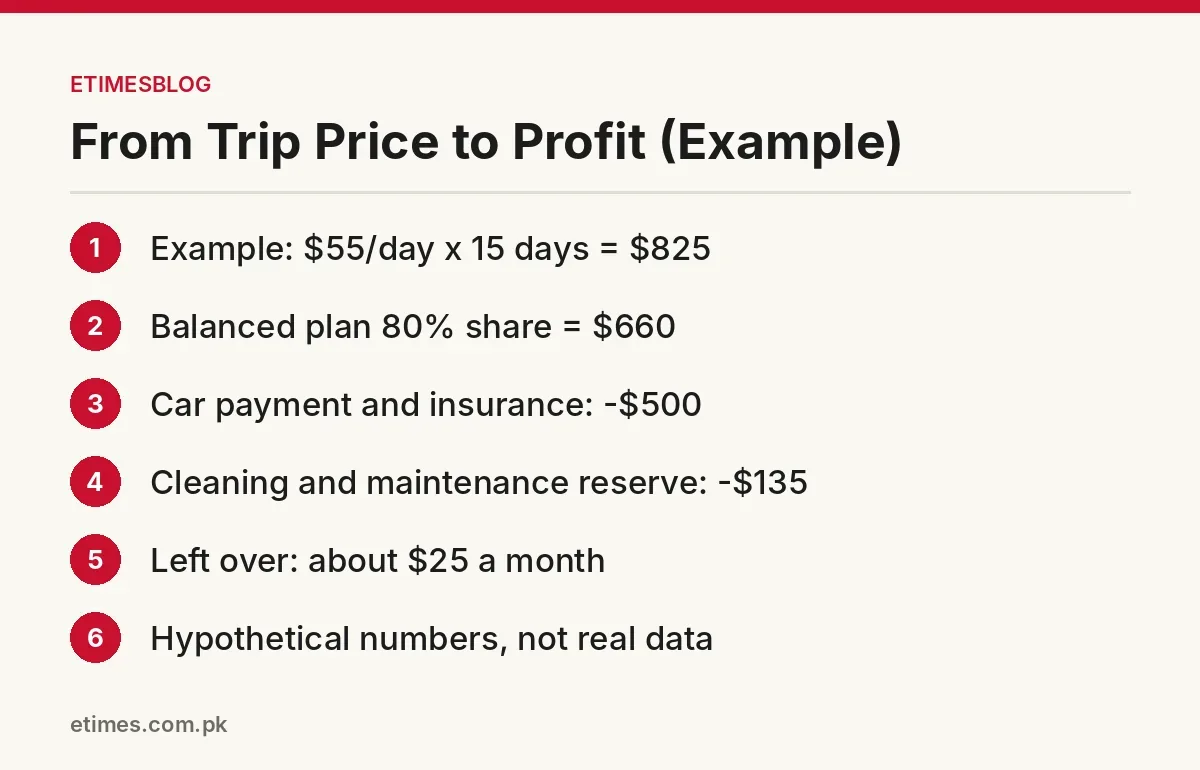
Step 1: Monthly revenue
Say your car rents for $55 a day and books 15 days a month. That's $825 in trip price. On the Balanced plan, your 80% host share is $660.
Step 2: Monthly hosting expenses
Now subtract what the car costs you to own and run. In this example:
Car payment: $350
Insurance: $150
Cleaning and supplies: $75
Maintenance and tire reserve: $60
That's $635 in expenses, which leaves $25 a month. On paper the car is "earning $660," but in practice it barely pays for itself. Raise the daily rate to $65 at the same bookings and your share becomes $780, which leaves $145.
Step 3: Add the costs people forget
The example still ignores depreciation, registration, parking, phone time and slow months. It also ignores damage claims, which brings us to the plan choice. Our guide to rental car pricing and daily rates shows how to build these into your rate.
Choosing a Plan by the Numbers
The 90% plan pays more per trip, but a single claim costs you more. You can work out roughly where the break-even sits.
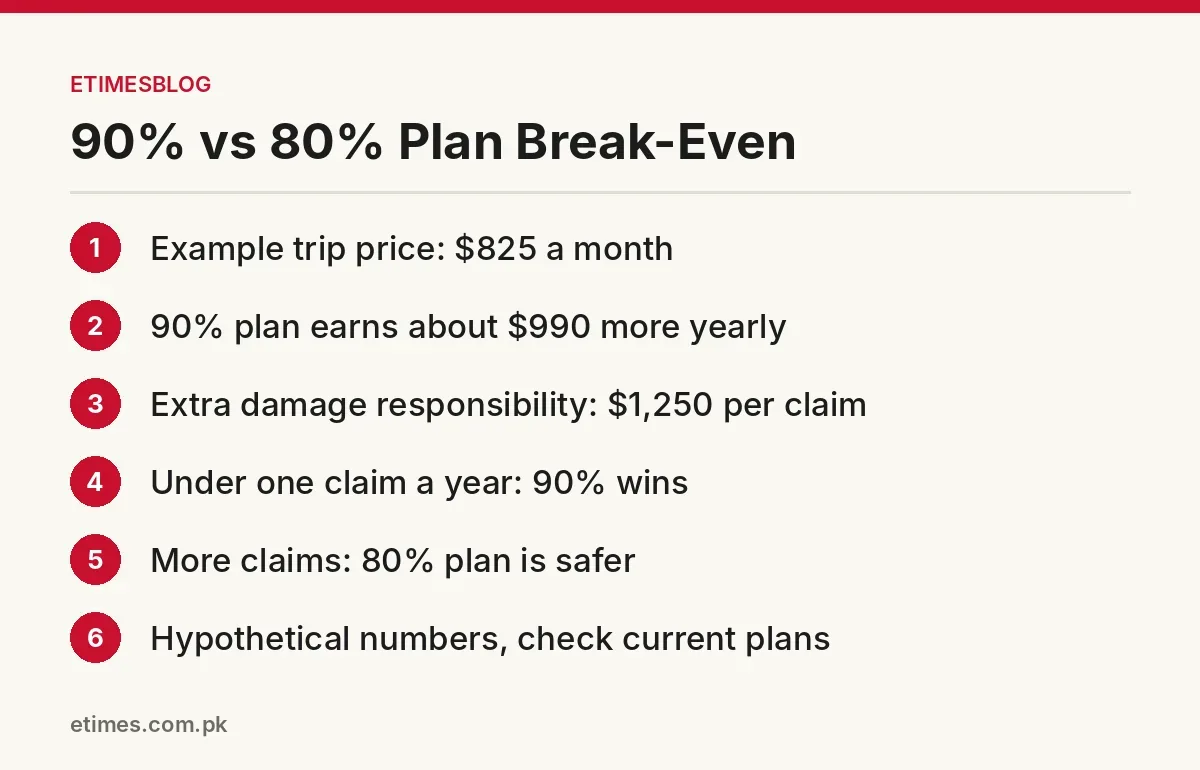
A simple break-even test
Using the same hypothetical $825 monthly trip price, moving from Balanced (80%) to More earnings (90%) adds about $82 a month, or about $990 a year. The extra damage responsibility per claim is $1,250 ($2,750 minus $1,500). So if you expect less than about one claim a year, the higher share likely comes out ahead in this example.
What I'd do
New hosts have no claim history and often no repair fund. I'd start on a plan where one bad trip won't empty your bank account. Switch to a higher host share once you have a few months of data and cash set aside. For the full comparison, read our guide to Turo protection plans.
Taxes: What You Keep After the IRS
Taxes are the last slice out of your Turo host earnings. I'm not a tax professional, so treat this as a starting point for a conversation with one.
The Turo 1099-K
Turo's US tax resources page says you'll get a Turo 1099-K only if you had more than 200 transactions and more than $20,000 in gross earnings, unless your state has a lower threshold. That matches the federal threshold the IRS reinstated under the One, Big, Beautiful Bill. Turo also notes the gross figure includes Turo fees and incentives, so it will be higher than what landed in your bank.
No form doesn't mean no tax
The IRS says you must report your income whether or not you receive a 1099-K. Turo's tax page adds that all US hosts must submit tax information, and Turo may pause payments if you don't. Keep receipts, loan papers and an odometer log from the first trip, because a tax pro can't deduct what you can't prove.
How to Raise Your Turo Profit Without Guessing
Once the math is clear, you can work on the levers that move it. Turo's own guidance points to availability, pricing, delivery options and host performance.
Levers that move the number
Open your calendar: a car that's available more days can book more days.
Price by season: raise rates on busy weekends and holidays, and trim them in slow weeks.
Cut empty time: leave a short buffer for cleaning, but not days of dead time.
Control expenses: shop insurance yearly and keep a maintenance schedule.
Pick the right car: a cheap-to-own car with steady demand often nets more than a flashy one. See our guide to the best cars for Turo.
Common mistakes
Treating gross payouts as income without subtracting the car's costs.
Picking the 90% plan with no cash to cover a $2,750 claim.
Spending reimbursements for fuel or tolls as if they were profit.
FAQ
How much do Turo hosts make per car?
Turo says US hosts averaged $10,489 per car in 2025, before ownership costs. Your own net depends on your car, location, pricing and expenses.
What percentage does Turo take?
It depends on your plan. US hosts keep 90%, 80% or 70% of the trip price, and some cities use a variable host share based on booking lead time.
Will I get a 1099-K from Turo?
Only above the federal threshold of more than $20,000 and more than 200 transactions, or a lower state threshold. You still have to report your income either way.
Do I keep the full fuel and toll reimbursements?
Yes, Turo says hosts receive 100% of approved reimbursements. They repay costs you already covered, so they aren't profit.
Final Thoughts
Turo host earnings only mean something once you subtract the car's real costs and pick a plan you can afford to claim on. Run the numbers for your own car before you list, then review them every month. If you're still at the beginning, our step-by-step guide to starting as a Turo host covers setup, and the car sharing platforms section has more.
This is general information, not legal, tax or insurance advice. Check the official terms for your situation.
ETIMESBLOG is independent and not affiliated with or endorsed by Turo, Getaround or any company mentioned.


Comments